
Arts and Crafts Movement in Miniature Furniture
Build Arts and Crafts miniature furniture with Mission style techniques. Learn quartersawn oak, through-tenons, and hammered copper hardware at 1/12 scale.
At the turn of the twentieth century, a reaction against industrialization and mass production swept through the design world. The Arts and Crafts movement, which had begun in England with the writings of John Ruskin and the work of William Morris, found its most distinctive American expression in the furniture of Gustav Stickley and his contemporaries. These makers championed honest materials, visible construction, and the dignity of handcraft, producing furniture that celebrated the worker’s hand rather than the machine’s precision.
For the miniaturist, Arts and Crafts furniture offers a uniquely satisfying challenge. The style depends on exposed joinery, carefully selected wood, and hardware made by hand. It is furniture where the construction is the decoration, where a through-tenon joint or a hand-hammered copper pull is meant to be seen and appreciated. Reproducing this at 1/12 scale means your joinery must be not just structurally sound but visually perfect, because it is on full display.
The Arts and Crafts Movement: Philosophy and Context
The Arts and Crafts movement emerged in England in the 1860s and 1870s as a response to the perceived ugliness and dehumanizing effects of industrial production. William Morris, the movement’s most prominent voice, argued for a return to handcraft and the medieval ideal of the artisan who designed, built, and took pride in the finished work.
In America, the movement took a somewhat different form. Gustav Stickley, working from his workshops in Syracuse, New York, developed what he called Craftsman furniture, a robust, rectilinear style built primarily from quartersawn white oak. His magazine, “The Craftsman,” published from 1901 to 1916, promoted not just furniture but an entire lifestyle built around simplicity, craftsmanship, and connection to nature.
Other notable American makers in the movement include the Roycrofters of East Aurora, New York, who combined furniture making with bookbinding, metalwork, and printing, and Charles Limbert, whose furniture incorporated cutout designs and prairie-influenced forms. The Greene brothers of Pasadena, California, created an extraordinary synthesis of Arts and Crafts principles with Japanese aesthetics in their architectural woodwork and furniture.
For the miniaturist, this rich variety of makers and approaches within the Arts and Crafts tradition provides endless design inspiration.
Defining Features of Arts and Crafts Furniture
Quartersawn Oak
The signature material of American Arts and Crafts furniture is quartersawn white oak. Quartersawing, in which the log is cut into quarters and then sliced radially, exposes the medullary rays of the oak, creating distinctive flecking patterns across the face of the board. This figured surface was celebrated by Stickley and his contemporaries as evidence of the wood’s natural character.
At 1/12 scale, finding wood with visible ray fleck patterns is challenging. The flecks that read clearly on a full-size tabletop are simply too large relative to a miniature surface. I have two approaches to this problem. First, I seek out quartersawn oak with particularly fine, tight ray fleck and use it for larger miniature surfaces like tabletops where the figure can be appreciated. Second, for smaller parts, I accept that the ray fleck will be less visible and focus instead on the other characteristics of oak, its warm color and strong grain structure, to convey the style.
In some cases, I use other fine-grained woods stained to an oak tone when the figure of actual oak is too coarse for the miniature piece. Cherry stained with a fumed oak tone can be remarkably convincing at 1/12 scale. This is a practical compromise that serves the visual character of the finished miniature.
Exposed Joinery as Decoration
This is the defining principle of Arts and Crafts construction. Where earlier furniture makers concealed their joinery behind smooth surfaces and applied decoration, Arts and Crafts makers celebrated it. Through-tenons, with the tenon end visible on the outside of the mortised piece, are perhaps the most characteristic structural element. Keyed tenons, where a wedge or key locks the tenon in place, add both visual interest and structural integrity.
At 1/12 scale, building visible through-tenons is exacting work. The mortise must be cleanly cut with sharp edges, because any roughness or tear-out is part of the visible surface. The tenon must fit snugly, projecting just slightly beyond the outer surface. I typically leave the tenon about 1/64 inch proud and either chamfer or round the exposed end.
For keyed tenons, I cut a small slot through the projecting tenon and insert a tiny wedge of contrasting wood. The wedge is usually about 5/64 inch long and less than 1/32 inch thick. At this scale, it is a fiddly operation that requires steady hands and good magnification, but the visual payoff is significant. A keyed through-tenon on a miniature table or chair immediately identifies the piece as Arts and Crafts.
I also use exposed pinned mortise-and-tenon joints, where a wooden pin driven through the joint from the outside locks the tenon in place. The pin is typically a tiny dowel of contrasting wood, about 1/64 inch in diameter, driven through a drilled hole and trimmed flush.
Rectilinear Forms
Arts and Crafts furniture is overwhelmingly rectilinear. Curves are rare. The forms are built from straight boards joined at right angles, with visual interest coming from the proportions, the wood, the hardware, and the exposed joinery. This geometric clarity makes accurate cutting and assembly essential. At 1/12 scale, every angle must be precisely 90 degrees, every surface must be flat, and every edge must be clean.
In some ways, this rectilinear construction is easier than the curves of Queen Anne or Federal furniture. You do not need to shape cabriole legs or bend oval chair backs. But the precision required for straight, clean work at this scale should not be underestimated. A square table that is not quite square looks wrong immediately.
Iconic Arts and Crafts Pieces in Miniature
The Morris Chair
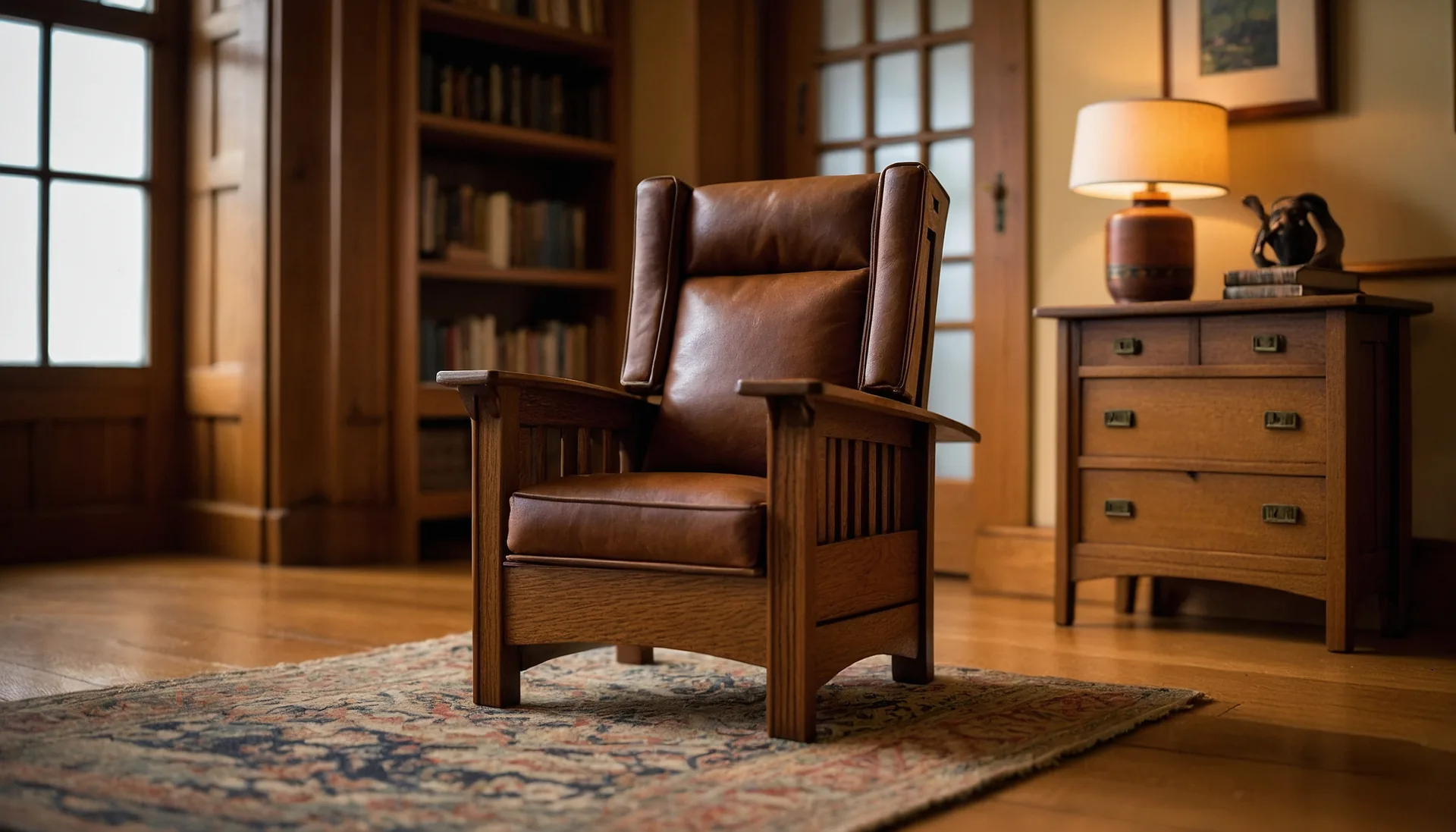
The Morris chair, named after William Morris though not designed by him, is perhaps the most recognizable piece of Arts and Crafts furniture. It is a large, comfortable armchair with an adjustable reclining back, wide flat arms, and typically a loose cushion seat and back. Stickley’s versions feature through-tenon arm joints, corbels supporting the arms, and a simple peg-and-notch mechanism for adjusting the back angle.
At 1/12 scale, a Morris chair is a wonderful project that showcases many key Arts and Crafts techniques. The frame is built from thin oak stock with through-tenon joinery at the critical connections. The arm supports are often shaped with a gentle taper or curve, one of the few curved elements in the style. The back adjustment mechanism can be functional in miniature, using a small pivoting bar that drops into notches on the rear posts.
The cushions are made from a firm foam core covered in leather or a period-appropriate fabric. Arts and Crafts upholstery tends toward leather in warm browns, or heavy canvas and linen in earth tones. At miniature scale, I use thin leather or suede for the most authentic effect.
Stickley Bookcases and China Cabinets
Stickley’s bookcases are architectural pieces featuring wide, flat stiles and rails, leaded or divided glass doors, and sometimes through-tenon construction in the side panels. A Stickley bookcase in miniature makes a stunning addition to a Craftsman-style dollhouse room.
The glass doors are built as miniature frames with thin muntins creating a grid pattern. The glass is simulated with thin clear acrylic. The proportions of the stiles and rails relative to the glass openings are critical to getting the Stickley look right. The framing members should feel substantial without being heavy.
Trestle Tables and Dining Furniture
Arts and Crafts dining tables typically feature thick tops, trestle or pedestal bases, and through-tenon or keyed-tenon joinery. The proportions are robust and grounded. At 1/12 scale, the table feels solid and substantial even though it is small enough to sit in your palm.
I build miniature Stickley-style tables from quartersawn oak whenever possible, joining the top boards edge to edge and fitting them to the base with the joinery exposed. The stretcher that connects the trestle supports often features a keyed through-tenon, which becomes the visual focal point of the piece.
Dining chairs in the style are typically straight-backed with leather or rush seats, vertical back slats, and pinned mortise-and-tenon construction. A set of six or eight matching miniature dining chairs around a trestle table creates a powerful period room setting.
Hammered Copper Hardware in Miniature
Arts and Crafts furniture hardware is as distinctive as the furniture itself. Drawer pulls, hinges, escutcheons, and decorative elements were typically made from copper or iron, often with a hand-hammered texture. The hardware was seen as an integral part of the design, not merely a functional addition.
At 1/12 scale, I make hardware from thin copper sheet and wire. For hammered pulls, I cut a small rectangle or shield shape from copper sheet, then texture the surface by tapping it with the rounded end of a small ball-peen hammer or a blunt nail. The hammering creates tiny dimples that catch the light and give the piece its handmade character.
Bail pulls are formed from copper wire bent to shape and attached through holes in a backplate. Strap hinges are cut from thin copper sheet and bent to fit. The warm tone of copper against the dark fumed oak is one of the most appealing visual combinations in furniture design, and it translates beautifully to miniature scale.
Finishing: The Fumed Oak Look
Stickley’s most characteristic finish was fumed oak, achieved by exposing the raw wood to ammonia fumes. The ammonia reacts with the tannins in oak to produce a deep, warm brown tone that penetrates the wood rather than sitting on the surface. The resulting color has a richness and depth that stains cannot quite match.
At miniature scale, I sometimes fume actual oak pieces by placing them in a sealed container with a dish of household ammonia. The process takes several hours to a day, depending on the depth of color desired. The results are excellent, and the fumed color responds beautifully to a clear finish of shellac or oil.
When working with substitute woods, I achieve a similar tone using a combination of dilute iron acetate solution, which reacts with tannins to darken the wood, followed by thin coats of amber shellac. The goal is a warm, brownish-amber tone that glows from within rather than a flat surface stain.
Arts and Crafts in the Broader Context
The Arts and Crafts movement occupies a fascinating position in furniture history. It looked backward to medieval ideals of handcraft while simultaneously anticipating the modern movement’s emphasis on function, honesty of materials, and integration of design with daily life. For the miniaturist, it bridges the gap between the elaborate period styles of the eighteenth century and the streamlined forms of the twentieth.
Building Arts and Crafts miniatures alongside pieces from other traditions, such as Shaker work, which shares the commitment to simplicity and honest construction, creates a collection that tells a meaningful story about the evolution of American craft ideals.
Visit my gallery to see examples of Arts and Crafts miniatures and other period pieces. If you have questions about techniques, materials, or commissions, please reach out through my contact page. The Arts and Crafts tradition, with its emphasis on the handmade and the authentic, feels especially relevant in an age of mass production, and I find great satisfaction in keeping its spirit alive at 1/12 scale.