
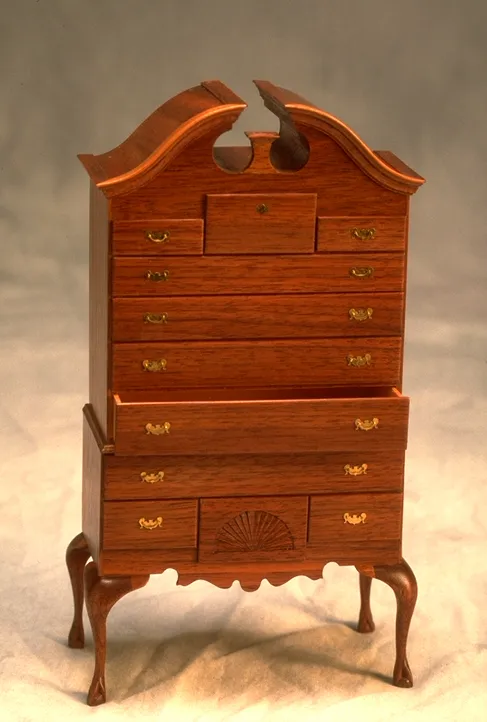
Federal Period Miniature Furniture: Elegance at 1/12 Scale
Master Federal period miniature furniture with Hepplewhite and Sheraton techniques. Learn stringing, banding, tapered legs, and inlay work at 1/12 scale.
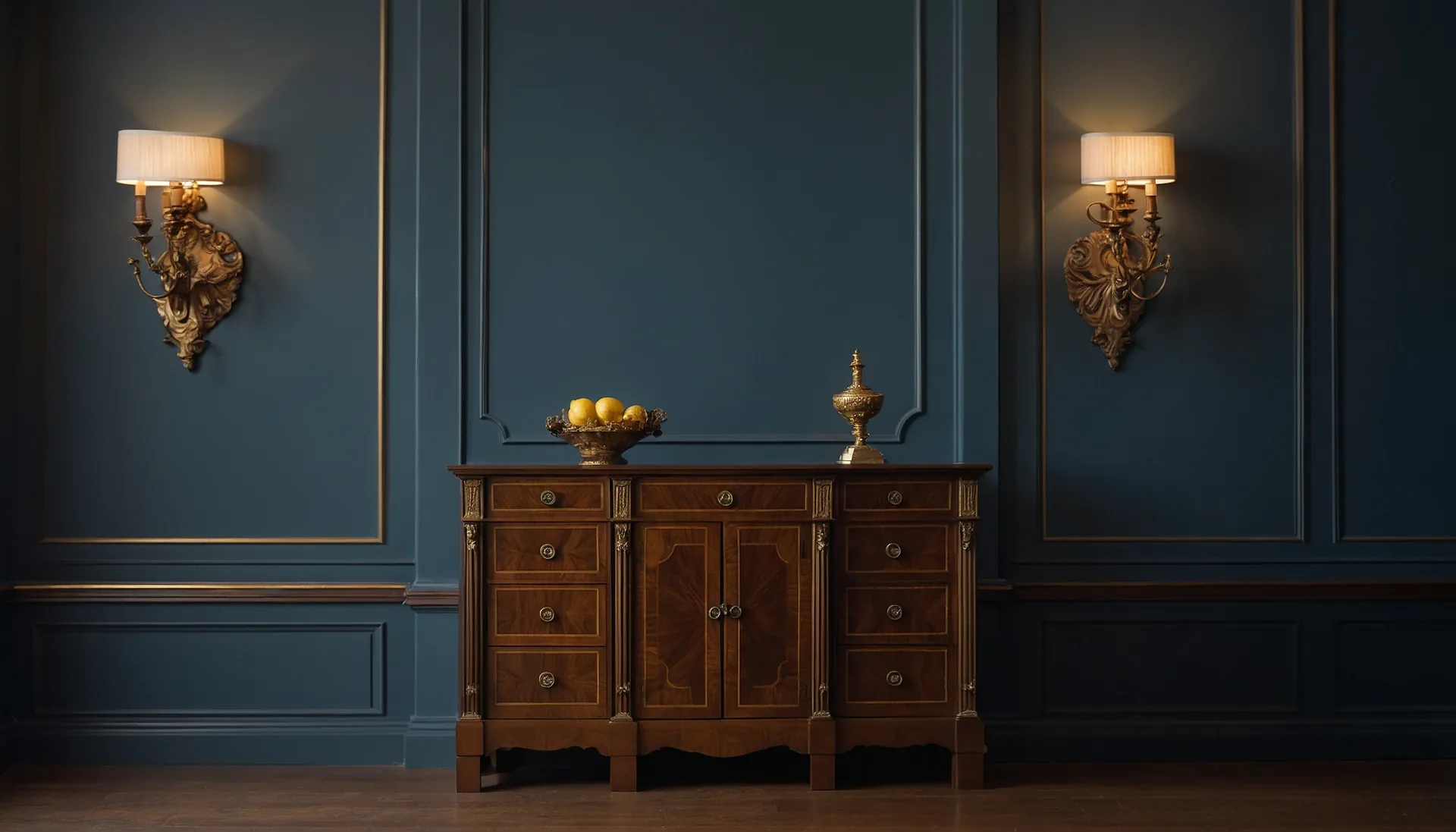
After the robust curves of Queen Anne and the carved exuberance of Chippendale, American furniture took a dramatic turn toward lightness, refinement, and geometric precision. The Federal period, roughly 1780 to 1820, brought the neoclassical designs of George Hepplewhite and Thomas Sheraton to American shores, where makers like Samuel McIntire of Salem and the Seymour workshop of Boston elevated them to extraordinary heights.
For the miniaturist, Federal period furniture presents a unique and fascinating challenge. The forms are deceptively simple, relying on perfect proportions and delicate decorative techniques like stringing, banding, and pictorial inlay rather than carved ornament. In many ways, Federal period furniture is harder to build well at 1/12 scale than more ornate styles, because there is nowhere to hide imperfections.
Hepplewhite vs. Sheraton: Understanding the Distinction
While the two names are often used interchangeably, Hepplewhite and Sheraton represent distinct design sensibilities within the Federal period.
Hepplewhite
George Hepplewhite’s “Cabinet-Maker and Upholsterer’s Guide,” published posthumously in 1788, championed graceful, flowing lines. Hepplewhite furniture is characterized by shield-shaped and oval chair backs, serpentine and bow-front case pieces, delicately tapered legs, and restrained use of inlay. The overall feeling is one of gentle curves contained within a disciplined neoclassical framework.
At 1/12 scale, Hepplewhite pieces are beautiful to build and to look at. A Hepplewhite shield-back chair, with its interlacing splat and tapered front legs, is one of the most elegant forms in the miniature furniture canon. The challenge lies in achieving the delicate proportions. Hepplewhite legs taper to remarkably fine points, and at miniature scale they must be thin enough to read correctly while remaining strong enough not to break during handling.
Sheraton
Thomas Sheraton’s “Cabinet-Maker and Upholsterer’s Drawing Book,” published in parts from 1791 to 1794, favored straighter lines and more geometric forms. Sheraton furniture features turned and reeded legs, rectangular chair backs with vertical elements, and case pieces with flat or slightly bowed fronts. Decorative treatment includes reeding, fluting, and applied carved ornament such as rosettes and swags.
The turned legs of Sheraton furniture require lathe work, which makes the construction approach different from Hepplewhite. At 1/12 scale, turning a slender, reeded Sheraton leg demands excellent lathe control and very sharp tools. The reeding itself, consisting of parallel convex ribs running vertically up the leg, is carved after turning using a fine gouge.
Defining Features of Federal Miniature Furniture
Tapered Legs
The square tapered leg is a hallmark of Hepplewhite design and one of the most demanding elements to execute at 1/12 scale. The leg starts at its full width where it meets the seat rail or case bottom and tapers evenly on two inner faces to a fine point at the floor. At 1/12 scale, the leg might taper from about 5/32 inch square at the top to less than 5/64 inch at the foot.
I shape tapered legs by hand using a small block plane and a sanding block with a flat, true surface. The taper must be perfectly straight, without wavering, and identical on all four legs. I tape all four legs together in a bundle and plane them simultaneously to ensure consistency. Any slight variation between legs is immediately apparent when the piece is assembled, because the geometric purity of the Federal style tolerates no irregularity.
Stringing and Line Inlay
Stringing is the single most characteristic decorative technique of Federal period furniture. It consists of thin lines of contrasting wood, typically holly or boxwood set into channels cut in a darker wood like mahogany, creating borders, panels, and geometric patterns on drawer fronts, tabletops, and case sides.
At 1/12 scale, stringing is extraordinarily fine work. A string line at full scale might be 1/16 inch wide. At 1/12 scale, that translates to about 0.005 inch, which is essentially a thread. In practice, I work somewhat wider than strict mathematical scale because lines that are truly to scale would be invisible. I use stringing material approximately 1/64 to 1/32 inch wide, which reads correctly to the eye while remaining practically achievable.
I cut the channels for stringing with a sharp marking gauge drawn along a straightedge, making two parallel cuts to define the width of the channel, then removing the waste between them with a fine chisel. The stringing material, thin strips of light-colored wood or commercially available miniature stringing, is glued into the channel and trimmed flush with a sharp blade.
Banding and Cross-Banding
Banding is a wider decorative border, typically cut from veneer with the grain running perpendicular to the edge of the piece. It creates a framing effect around drawer fronts and tabletops that is immediately recognizable as Federal.
At miniature scale, I cut banding strips from thin veneer sheets. The strips are perhaps 1/32 to 5/64 inch wide, with the grain running across their width. I glue them into shallow recesses let into the surface of the piece, then sand everything flush. The contrast between the cross-grain banding and the long-grain background creates the visual frame that defines the Federal look.
Pictorial Inlay
The most ambitious Federal decoration involves pictorial inlay, featuring eagles, urns, bellflowers, fans, and other neoclassical motifs composed from contrasting woods. The great Baltimore and Salem makers were particularly known for this work.
At 1/12 scale, true pictorial inlay is at the extreme edge of what is possible. I have created simplified versions of eagle and fan inlays using tiny pieces of holly and ebony set into recessed areas. The key is to reduce the design to its essential elements. A bellflower drop, which at full scale might contain fifteen or twenty individual petals, might have five or six at miniature scale. The visual impression is correct even though the detail is simplified.
Classic Federal Pieces for Miniature Work
The Demilune Table
The demilune, or half-round, table is a quintessential Federal form. Its semicircular top sits on four or six tapered legs, and the apron often features inlaid banding and a central fan or shell motif. At 1/12 scale, the curved apron requires careful bending or laminating of thin stock around a form. I typically steam-bend a thin strip of wood around a semicircular mold and glue it in position.
The Secretary Desk
Federal secretary desks are more restrained than their Chippendale predecessors. The slant front or fold-down writing surface reveals a fitted interior, and the exterior features flat surfaces decorated with stringing, banding, and sometimes oval patera inlays. The bookcase top typically has glazed doors with delicate muntins creating geometric patterns.
The muntins in Federal glazed doors are remarkably thin and create elegant patterns of diamonds, ovals, or pointed arches. At 1/12 scale, I build these from strips of wood less than 1/32 inch wide, bent and joined to form the geometric pattern. The glazing is thin acrylic sheet set behind the muntin framework.
Oval-Back Chairs
The oval-back chair is one of Hepplewhite’s most graceful designs. The chair back consists of an oval frame with a carved or pierced central element, supported on raking rear stiles that flow from the seat to the top of the oval. The front legs are square-tapered.
Building an oval-back chair in miniature requires bending the oval frame from a thin strip of wood soaked and bent around an oval form. The curve must be smooth and symmetrical. The central splat or carved element is fitted into the oval and the joints are reinforced from behind.
The Sideboard
The Federal sideboard is a showpiece that combines all the characteristic elements: tapered or turned legs, serpentine or bow-front case, extensive stringing and banding, and sometimes bellflower inlay cascading down the legs. Building one at 1/12 scale is a significant project that showcases virtually every Federal decorative technique.
Finishing Federal Miniatures
Federal furniture was typically finished in warm, medium tones that allowed the figure of the mahogany to show through. I use thin coats of shellac over bare wood, sometimes with a light wash of reddish-brown stain to warm the tone. The finish should be smooth and refined, with a soft satin luster rather than a high gloss.
The contrast between the dark primary wood and the light inlay lines is critical to the visual effect. I am careful not to stain over inlay work, and I sometimes seal the inlay with a clear finish before applying tinted stain to the surrounding wood to keep the lines crisp and bright.
Why Federal Furniture Is Deceptively Difficult
I tell fellow miniaturists that Federal period furniture is deceptively difficult. The forms look simple, the decoration appears subtle, and there are no elaborate carvings to struggle with. But the precision required is unforgiving. A tapered leg that wavers slightly, a stringing line that is not perfectly straight, or proportions that are even marginally off will undermine the entire piece. The Federal style achieves its beauty through perfection of proportion and refinement of detail, and that is hard to fake at any scale.
If you are drawn to the elegance of the Federal period, I encourage you to start with a simple project like a tapered-leg side table with stringing. This will give you a feel for the precision the style demands before you tackle more complex pieces. You can see Federal and other period miniatures in my gallery, and I welcome questions through my contact page.
Continue Your Journey
Related Articles
Chippendale Miniature Furniture: 1/12 Scale Guide
Master Chippendale miniature furniture with expert techniques for ball and claw feet, ribbon-back chairs, and ornate carvings at dollhouse scale.
The Art of the Miniature Highboy: A Maker's Guide
Complete maker's guide to building a miniature highboy at 1/12 scale. Learn leg turning, drawer construction, and broken pediment techniques step by step.
Queen Anne Miniature Furniture: History and Techniques
Explore Queen Anne miniature furniture history and techniques. Learn to craft cabriole legs, pad feet, and shell carvings at 1/12 scale from a master craftsman.