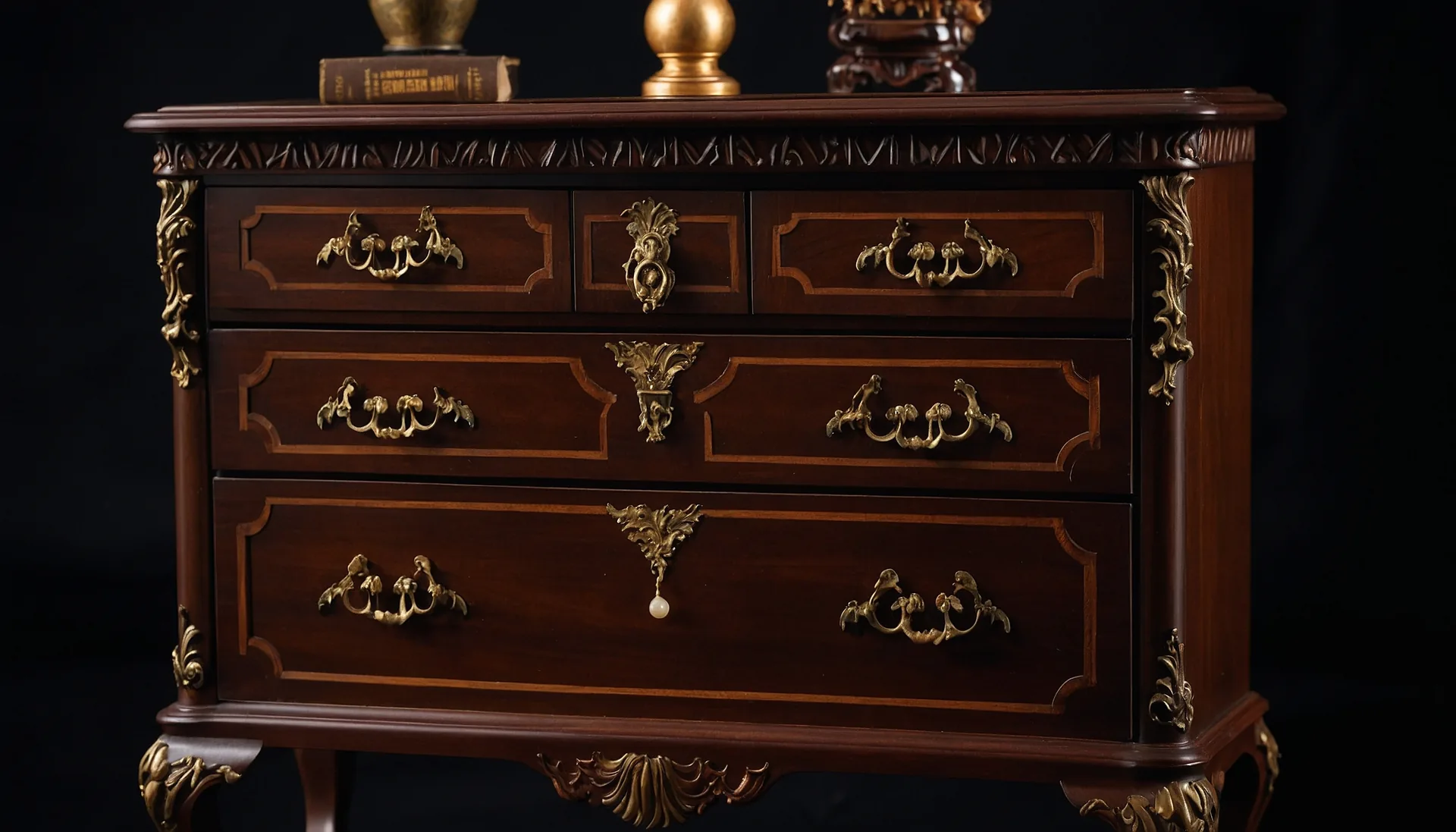
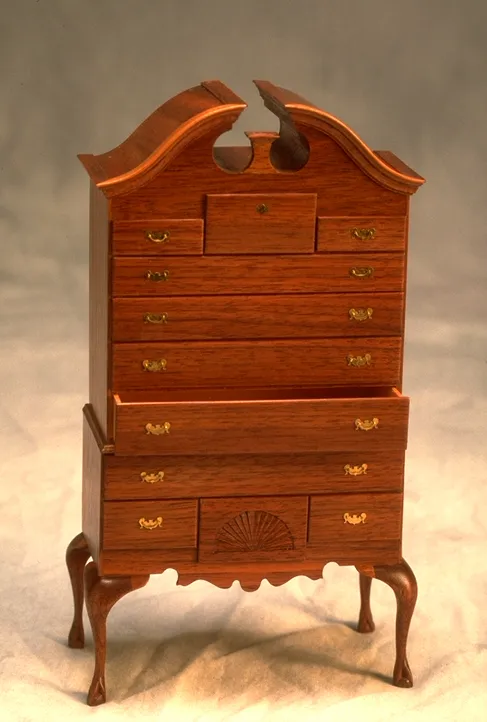
The John Goddard Block-Front Secretary Desk in Miniature
Explore the iconic John Goddard block-front secretary desk in miniature. Learn to reproduce shell carvings, block fronts, and pigeonholes at 1/12 scale.
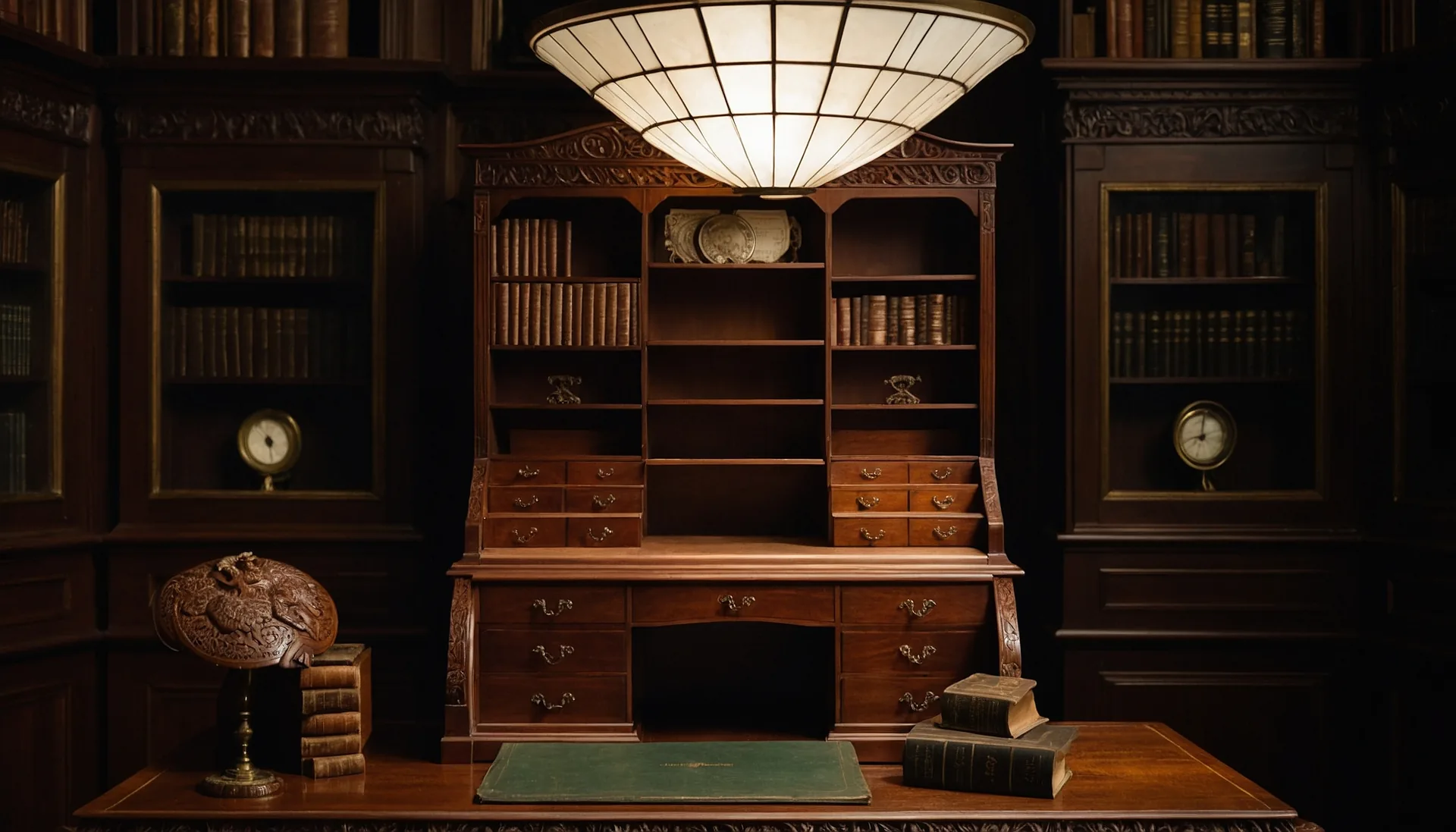
In the world of American furniture, few pieces command more reverence than the block-front secretary desks made by John Goddard and the Townsend-Goddard workshop of Newport, Rhode Island. These desks, built in the mid-to-late eighteenth century, represent the pinnacle of American cabinetmaking. The combination of architectural block-front facades, exquisitely carved shells, and complex interiors filled with drawers and pigeonholes makes them objects of extraordinary beauty and craftsmanship.
Reproducing a Goddard block-front secretary desk at 1/12 scale is one of the most ambitious projects a miniaturist can attempt. It is a piece I return to again and again because it challenges every skill I possess and because the finished result captures something truly special about American craft heritage. In this article, I want to share the history behind these desks, explain what makes them so remarkable, and walk through the techniques involved in building one at miniature scale.
The Story of John Goddard and Newport Furniture
John Goddard was born in 1723 and worked in Newport, Rhode Island, as part of an extended family of cabinetmakers known collectively as the Townsend-Goddard school. Newport in the eighteenth century was a prosperous port city, and its wealthy merchants demanded furniture of the highest quality. The Townsend-Goddard workshop responded with pieces that were technically brilliant, aesthetically refined, and entirely distinctive.
The block-front form, featuring a facade divided into three vertical panels where the outer two project forward and the center recedes, was not unique to Newport. It appeared in Boston and other centers. But the Townsend-Goddard makers elevated it to an art form by topping each block with a beautifully carved shell. The convex shells on the raised outer blocks and the concave shell on the recessed center block create a rhythm of projection and recession that gives these pieces an almost sculptural quality.
In 1989, a Goddard secretary desk sold at auction for over twelve million dollars, making it the most expensive piece of furniture ever sold at that time. The price reflected not just rarity but the universal recognition of the desk as a masterwork of design and execution. For the miniaturist, that same masterwork becomes an intensely personal challenge.
Why This Desk Is Considered the Pinnacle
Several factors combine to make the Goddard block-front secretary desk exceptional.
Architectural Complexity
The desk is really two pieces of furniture in one. The lower section is a slant-front desk with a writing surface that folds down, revealing an interior fitted with small drawers, pigeonholes, and document dividers. Below the writing surface are three or four full-width drawers with the iconic block-front and shell treatment. The upper section is a bookcase with glazed or paneled doors, shelves, and sometimes additional small drawers, crowned by a bonnet top with carved finials.
The Block-Front and Shell Carvings
The block front is not merely applied decoration. Each drawer front is carved from a single thick board so that the raised and recessed blocks are integral to the surface. This requires drawer fronts of exceptional thickness and quality. The shells that cap the blocks are carved directly into the wood, blending seamlessly into the blocking below.
The convex shells on the outer blocks typically have a series of radiating lobes that fan outward from a central point, with a scalloped outer edge. The concave shell on the center block inverts this form, curving inward. The precision and consistency of these carvings across the multiple drawer fronts is what separates great work from merely good work.
The Interior
Opening the slant front reveals a miniature architectural interior that is a marvel of organization. Typical Goddard desk interiors include a central prospect door, often with its own carved shell or architectural pediment, flanked by columns or pilasters. Behind and around this central feature are banks of small drawers, pigeonholes for letters and documents, and sometimes secret compartments hidden behind sliding panels.
At 1/12 scale, this interior becomes an extraordinary challenge. Each tiny drawer must be individually built, fitted, and equipped with a pull. Pigeonholes must be evenly spaced and cleanly constructed. The prospect door must open on tiny hinges to reveal whatever lies behind it.
Reproducing the Block Front at 1/12 Scale
Material Selection
The original Goddard desks were built primarily from mahogany, with secondary woods like chestnut, tulip poplar, and white pine used for drawer sides, backs, and internal structure. For miniature work, I use a fine-grained hardwood for the exterior, often cherry or pear, which carves cleanly at small scale. For the block-front drawer fronts, I need stock thick enough to accommodate the relief of the blocking, typically about 1/8 to 5/32 inch.
Shaping the Blocks
I begin each drawer front by marking the three vertical divisions on the face. The outer thirds will project forward and the center third will be recessed. Using a combination of a small shoulder plane, files, and careful chisel work, I remove material from the center block to create the recession and shape the transitions between the blocks.
The transitions are not sharp steps. On the original desks, the surfaces curve gently from one plane to another, creating soft shadows that give the facade its characteristic depth. At miniature scale, these transitions must be handled with particular care. Too abrupt and the blocks look like steps. Too gradual and the blocking reads as flat. I check the profile constantly by holding the piece at eye level and looking along the surface.
Carving the Shells
The shells are the crowning glory of the block front and the most technically demanding element. At 1/12 scale, each shell is roughly 3/16 to 9/32 inch wide. Within that space, I need to carve a convincing pattern of radiating lobes with clean edges and consistent proportions.
I start by establishing the overall form, convex for the outer shells and concave for the center shell. Then I mark the lobe divisions lightly with a pencil. Using my finest V-gouge, I incise the channels between the lobes, working from the center outward. Each lobe is then individually shaped to a slight ridge along its center. The scalloped outer edge is cut with a sharp knife.
The concave center shell is more difficult because you are carving into a hollow. I use curved gouges to establish the concavity first, then lay in the lobe details. Working in this recessed surface requires careful tool control to avoid slipping and cutting into adjacent areas.
I typically carve several practice shells before attempting the final pieces. The muscle memory and tool control that come from repetition make a significant difference in the final quality.
Building the Interior
The desk interior is where the miniaturist earns their reputation. A Goddard secretary desk interior might contain a dozen or more small drawers, each one a perfectly constructed miniature box with a front, back, two sides, and a bottom. At this nested scale, some of these drawers are barely 5/16 inch wide, which is small even by 1/12 scale standards.
Pigeonholes and Dividers
I build the pigeonhole assembly as a separate unit that slides into the desk case. The vertical dividers and horizontal shelves are cut from thin stock, around 1/32 inch thick, and assembled in a grid pattern. Precision is essential because any irregularity in spacing is immediately visible.
The Prospect Door
The central prospect door is a focal point of the interior. On the finest Goddard desks, it features its own miniature architectural treatment, perhaps a carved shell, a broken pediment, or engaged columns. I build this as a tiny working door hung on the smallest hinges I can find or make. Behind it, there may be additional pigeonholes or a small drawer.
Small Interior Drawers
Building the interior drawers is repetitive but requires patience. Each drawer is constructed from strips of wood less than 1/32 inch thick. I cut the parts on a small table saw or with a razor saw and assemble them with glue. The pulls on these tiny drawers are made from the finest brass wire, bent into a loop and inserted through a drilled hole. At this scale, each pull is only about 1/32 to 5/64 inch wide.
I discuss more general miniature drawer techniques in my complete guide to 1/12 scale furniture and in the highboy guide.
The Upper Case and Bonnet Top
The bookcase upper section of the secretary desk features shelves behind doors, either glazed with tiny panes or solid panels. The doors are built as miniature frames with mortise-and-tenon joints at the corners. For glazed doors, I set thin pieces of clear acrylic into the frame openings to simulate glass.
The bonnet top follows the same construction approach as on a highboy or tall case clock. Scrolled pediment boards, carved rosettes, and turned flame finials create the characteristic silhouette. This is the third or fourth time these skills appear in a single project, which illustrates how the block-front secretary desk draws on virtually every technique in the miniaturist’s toolkit.
Finishing and Hardware
I finish the exterior in a warm mahogany tone, using pigmented oil stain followed by many thin coats of shellac. The original Goddard desks have aged to a deep, rich brown with remarkable depth and warmth. Building up shellac in thin layers, rubbing each one smooth, approaches this quality.
Brass hardware, including bail pulls for the large drawers and tiny knobs for the interior drawers, completes the piece. I make the exterior pulls from brass sheet and wire, following the patterns found on original Goddard desks.
A Lifelong Pursuit
The Goddard block-front secretary desk in miniature is not a project you complete quickly. It represents weeks of focused effort and draws on skills developed over years. But the result is a piece that embodies the highest achievement in American furniture, translated faithfully into 1/12 scale.
If you would like to see this and other complex miniature pieces, please visit my gallery. For commissions or questions about any of the techniques described here, I welcome your inquiries through my contact page.